
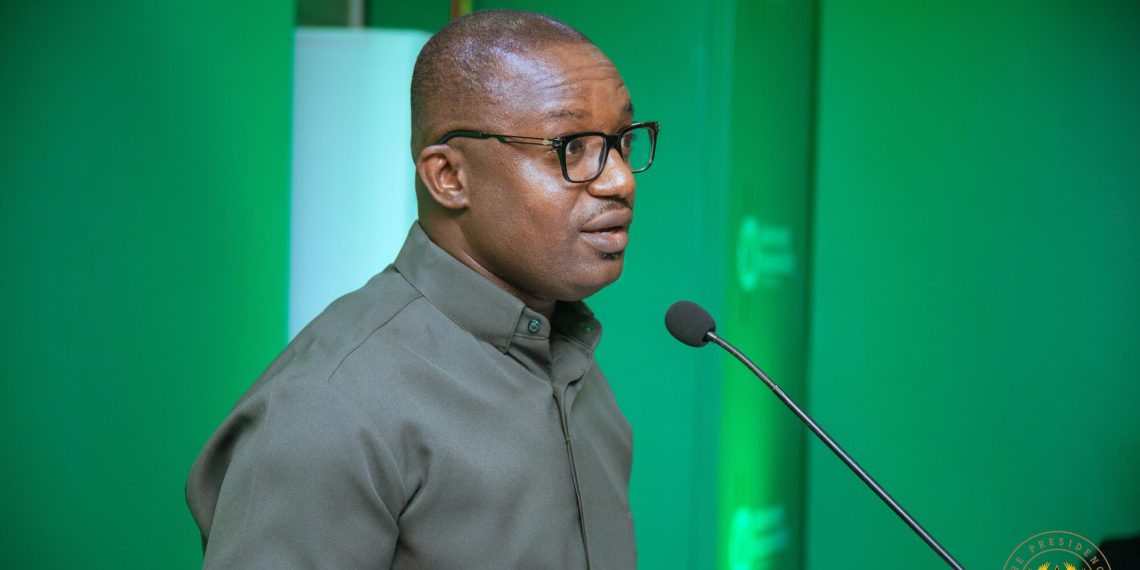

The committee established by the Energy and Green Transition Minister, Dr. John Abdulai Jinapor, to investigate the fire outbreak at the Akosombo Substation has revealed that the incident was caused by insulation failure resulting from the ageing condition of the facility and not by any deliberate human action.
The committee’s findings were presented to the Minister on Thursday, where the report stated that the fire was the result of a technical and structural defect rather than sabotage, as speculated.
Chairman of the committee, Engineer William Amuna, explained that the fire originated in the changeover section of the low-voltage (LV) panel, where electrical cables installed several decades ago had significantly deteriorated, noting that the affected structure dates back to around 1964 and that many of the cables had become brittle due to prolonged use.
The deterioration led to insulation failure, causing an electrical fault that allowed current to flow abnormally through the metal encasements.
According to Engineer Amuna, the initial fault was detected by the primary power supply from the powerhouse, which automatically tripped at 311 amps. However, a secondary transformer immediately assumed the load and continued supplying power to the faulted section.
According to Engineer Amuna, the second transformer was configured to trip only at 450 amps, allowing electricity to continue feeding into the fault, which generated excessive heat, causing the cable insulation materials to ignite.
The fire subsequently spread rapidly through interconnected panels and numerous control cables within the substation. Given the scale of the facility, which serves 11 outgoing circuits, the blaze quickly engulfed a significant portion of the control infrastructure.
Engineer Amuna stressed that the investigation found no evidence of human interference or intentional actions that contributed to the incident.
“The fire started from insulation failure in some of the cables within the LV panel and not from anyone deliberately manipulating equipment,” he stated.
The committee has recommended both immediate and long-term interventions to enhance the safety and reliability of the facility.
As part of the interim measures, protection and control functions currently handled by the damaged station are being transferred to the Akosombo Power Plant through a collaborative arrangement involving Ghana Grid Company Limited and Volta River Authority.
The committee expects this temporary arrangement to be completed by the end of August.
In addition, the committee has recommended the construction of a new permanent control building to replace the ageing facility. Engineer Amuna indicated that the model for the proposed structure would be based on the modern facilities at the Pokuase Substation, which meet current safety standards.
He expressed confidence that a state-of-the-art control building could be completed within 18 to 24 months.
Receiving the report, Mr. Jinapor assured the committee that the government would thoroughly review and implement its recommendations.
He commended engineers and technical staff for their swift response in restoring the electricity supply following the incident, but emphasised that accountability would be pursued should any negligence be established.
The Minister further described the incident as a wake-up call for the country’s energy sector, stressing the need to strengthen maintenance practices, improve emergency response systems, and increase investment in power transmission infrastructure.
He disclosed that some corrective actions had already been introduced based on preliminary findings provided by the committee.
The fire outbreak occurred on April 23 when operations at the Akosombo Substation were disrupted, affecting electricity transmission and supply to several parts of the country. In a statement issued after the incident, Ghana Grid Company Limited indicated that the fire had impacted both power generation and transmission within the national grid, leading to outages in multiple areas.
The committee’s report is expected to guide future investments and maintenance strategies aimed at improving the resilience and reliability of Ghana’s electricity transmission network.

Leave a Reply